
Woodland Center Release Meanings
Woodland Center Correctional Facility is operated by the Michigan Department of Corrections. It is not a wing of the Livingston County Jail. A person who departs WCC can remain in state custody at another prison. A community parole is also not a full sentence discharge. Parole means prison confinement ended while MDOC supervision and jurisdiction continue. Discharge means the sentence or supervision jurisdiction ended.
OTIS is the primary public status record. A changed facility with a prison status points to transfer, not release. PAROLE plus a Date Paroled supports completed departure from prison into an approved community placement or supervision setting. DISCHRG indicates that MDOC jurisdiction ended, although the listed reason and date still need to be read. This facility-specific distinction is more reliable than searching a county roster that does not cover state prisoners.
Search Woodland Center Releases
Open the Michigan OTIS page and enter the six-digit MDOC number when known. That unique number overrides other criteria. Without it, a normal search requires a last name. First name, gender, age, race, offender status, and scars, marks, or tattoos can narrow a result. A last-name wildcard works after at least three initial letters, such as Smi*.
- Search by MDOC number or last name and optional filters. Do not assume the commitment name is the person’s current legal name.
- Compare the offender number, date of birth, sex, race, and other identifiers before opening a record.
- Read Status and Location first. Another prison or an in-transit location does not show community release.
- Check Date Paroled for completed prison departure. Treat the Parole Board Jurisdiction Date as eligibility, not an actual exit date.
- For
DISCHRG, record the discharge date and reason. If the public record is no longer present, move to MDOC records or the sentencing court.
The full Livingston County search path is available through the released-inmate records hub, but a WCC prisoner remains an MDOC lookup even though the prison is located in Livingston County.
Note: OTIS excludes county-jail-only sentences, so a missing match may reflect the custody system rather than a Woodland release.
Woodland Center OTIS Release Fields
OTIS field labels answer separate questions. Date Paroled is retrospective evidence of prison departure. Parole Board Jurisdiction Date is the Earliest Release Date, which ordinarily marks the first point at which the Board may authorize parole for an eligible indeterminate sentence. Maximum Date is a potential outer discharge calculation. None should be renamed or collapsed into a promised release day.
| OTIS field or code | Meaning for a WCC search |
|---|---|
| Location | Shows the reported prison or supervision location; a changed prison can mean transfer. |
PRISON | A legal or system status that requires the physical Location field to be checked. |
PAROLE | Prison release occurred, but MDOC supervision continues. |
| Date Paroled | Shows when the person actually left prison on parole. |
| Parole Board Jurisdiction Date | The Earliest Release Date, meaning eligibility rather than a grant. |
| Maximum Date | A potential maximum discharge date, subject to lawful calculation. |
DISCHRG | MDOC jurisdiction ended; read the accompanying reason and date. |
The official OTIS field guide gives the status and release-date definitions used in a Woodland Center Correctional Facility result.
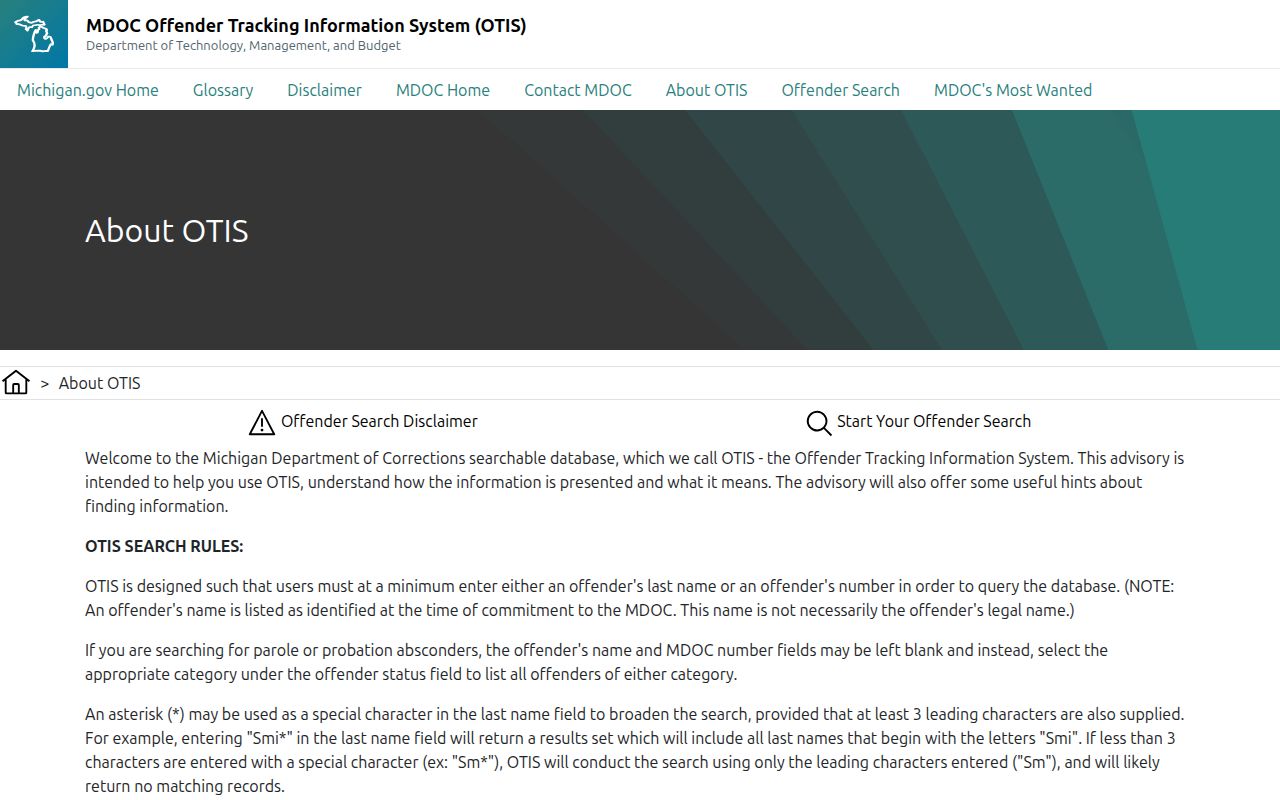
The field guide makes clear why Date Paroled carries different evidentiary weight from the earlier eligibility date.
Woodland Center Records Contact
The facility can address institutional information that is lawfully disclosed. Public release status still begins with OTIS, while a formal discharge certificate or other state correctional record belongs with MDOC records or FOIA staff. A complete PENPACK is restricted to duly recognized criminal-justice authorities conducting official business and is not a general-public record package.
Woodland Center Correctional Facility (WCC)
9036 E. M-36
Whitmore Lake, MI 48189
(734) 449-3320
Public email: mdoc-woodland-public@michigan.gov
For current prisoner records, MDOC lists Corr_Records_Info@michigan.gov. Past prisoner records up to six years post-release use MDOC-Records_Retention@michigan.gov. FOIA requests use MDOC-FOIA@michigan.gov; the published coordinator phone is (517) 335-4194, and the mailing address is P.O. Box 30003, Lansing, MI 48909. Name the exact existing document sought.
Woodland Center Facility Profile
Woodland Center opened in 2009 and houses males age 18 and older in security Levels I, II, and IV. MDOC lists capacity at 468. The institution’s functions include inpatient mental-health care, crisis stabilization, infirmary and clinic work, a Level I unit, and a Level II dialysis unit.
Those clinical and security roles make location changes especially important to interpret with care. A prisoner may move elsewhere in MDOC for treatment, placement, security, or other correctional reasons. Nothing about a different facility name, by itself, proves a release into the community. OTIS status and Date Paroled must support that claim.
Woodland Center Parole Timing
Michigan uses indeterminate felony sentencing for many offenses. A judicial minimum and maximum operate with Michigan Parole Board authority. The Earliest Release Date identifies an eligibility point. It is not an appointment for release. The Board may grant, deny, defer, or later rescind an action where the law permits. Another sentence, detainer, corrected judgment, resentencing, or misconduct consequence can also change the practical result.
Michigan truth in sentencing should not be described as a universal 85% rule. For covered offenses, a prisoner generally serves the full judicial minimum before parole eligibility. MCL 791.234 governs key eligibility and jurisdiction points, while MCL 791.233 governs parole release and conditions. Older cases can fall under earlier credit rules based on the offense date. Quote the actual OTIS date and status rather than hand-calculating a Woodland Center release.
Note: Parole eligibility is a date for Board authority, while Date Paroled records a prison departure that already occurred.
Request Woodland Center Release Proof
OTIS generally displays discharged people only through three years after supervision discharge. MDOC says computerized prisoner records date to about 1980, but public OTIS retention is much shorter. For an older WCC event, use MDOC records, the sentencing court, or the Archives of Michigan based on the time period and document needed.
A narrow public request can seek a nonexempt CSJ-130, Certificate of Discharge/Termination of Sentence, CAX-119, Parole Board Order for Parole, or the portion of a Time Review and Disposition sufficient to show the release type and date. MDOC policy also names the CSJ-169, Parole Processing Checklist and CSJ-170, Discharge Processing Checklist. Access and redaction rules still apply.
The MDOC FAQ describes discharge-certificate and PENPACK limits. Ask for one named releasable document rather than the restricted complete package. Court-derived sentence errors should go to the sentencing court; supervision or status errors should go to MDOC or the listed field office.
Note: Public OTIS retention, MDOC records retention, and archival custody are separate horizons and should not be treated as one deadline.
Woodland Center Transfer Hold Checks
A WCC location change normally stays within MDOC unless official records identify another sovereign or placement. If a release plan is blocked by an active sentence, warrant, detainer, or another agency’s custody, the Earliest Release Date does not override that hold. Wait for operative status and completed processing before describing a community release.
ICE’s locator can be relevant only when an official movement or case record indicates immigration custody. The ICE Online Detainee Locator System covers current detainees and people released from ICE custody during the preceding 60 days. A match means the question has moved into the ICE system. It does not convert a Woodland Center transfer into a discharge. Older immigration-custody questions require ICE contact or records because the public horizon is limited.
Woodland Center Release Facility Context
Whitmore Lake has two names that can be confused in old facility directories. Woodland Center Correctional Facility is an active adult MDOC institution that opened in 2009. Maxey Training School was a juvenile facility and closed in 2015. A result that claims a currently held or newly released adult is at Maxey is stale or wrong, and adult OTIS should not be used to reconstruct confidential juvenile matters.
The Livingston County Jail in Howell is a separate local system that grew from 62 beds in 1972 to 411 after several expansions. Its booking, bond, and jail-release records do not establish a WCC parole or discharge. Likewise, Woodland’s OTIS record does not supply the county jail’s physical exit time. The Livingston County Jail release route applies only when that county facility was the relevant custodian.
Woodland Center Post-Release Supervision
MDOC’s Parole Release Unit coordinates approved placements from correctional institutions into the community. Once OTIS shows PAROLE and a Date Paroled, the person has left prison but remains under MDOC jurisdiction. The OTIS Location field may identify the relevant supervision area. Parole is not final discharge.
The Michigan Parole Board is the sole paroling authority for felony offenders committed to MDOC. A later DISCHRG status shows the end of jurisdiction when read with its date and reason. An absconder code shows unresolved supervision, not successful discharge. Capture the exact status word, dates, location or office, and access date before contacting the responsible MDOC field office for information it may lawfully disclose.