
Livingston Projected Versus Actual Release
A projected or scheduled date is a calculation based on the current sentence data. An actual release date records that custody ended in the named system. Michigan OTIS commonly labels the key prospective prison field “Earliest Release Date,” also described as the Parole Board Jurisdiction Date. It is the first point when the Board may authorize release on an eligible indeterminate sentence. It does not say that parole was granted or that processing finished that day.
Another OTIS field, Date Paroled, is retrospective. It is stronger proof that the person left prison for parole. Maximum Date is a separate potential outer boundary for MDOC jurisdiction, subject to the lawful computation and other sentences. A county jail release time comes from the jail movement or release record, not from OTIS. Court entries explain the legal event, but the signed order and the physical exit can occur at different times.
Find Livingston Projected Release Dates
Start by classifying the custody. The Livingston County released inmate lookup can help distinguish the jail, MDOC, court, federal, and immigration paths. Do not use a live jail roster as proof of a past release. A name may disappear because of transfer, a data limit, or another agency taking custody.
- Confirm whether the person is pretrial, serving a county sentence, serving an MDOC sentence, or in federal custody.
- For MDOC, search OTIS by the unique offender number when known, or by last name and filters.
- Open the matched profile and read Status, Location, Parole Board Jurisdiction Date, Maximum Date, Date Paroled, and every sentence entry.
- For Livingston County Jail, read the 53rd District or 44th Circuit Court judgment, then ask jail records for the recorded or computed release information.
- Check for consecutive sentences, detainers, parole action, resentencing, or another agency hold before treating the date as final.
- After release is expected, verify the event with the responsible agency or a notification record.
Note: Livingston County publishes no online jail release-date calculator, so a homemade county-sentence calculation should not replace the official record.
Livingston OTIS Release Date Fields
The direct OTIS search interface requires a last name or MDOC offender number. The six-digit number is unique and overrides other search criteria. Searchers may narrow a name result by gender, age range, race, status, and scars, marks, or tattoos. A wildcard may follow at least three starting letters of a last name. Identity still must be checked carefully because the displayed commitment name may differ from a later legal name.
| OTIS field | How to read it | Release-date limit |
|---|---|---|
| Parole Board Jurisdiction Date | Earliest Release Date for a prison sentence | Eligibility point, not a release promise |
| Maximum Date | Potential maximum discharge calculation | May change with lawful recalculation or other sentences |
| Date Paroled | Date the person actually left prison on parole | Release occurred, but MDOC supervision continues |
| Status | PRISON, PAROLE, PROB, DISCHRG, or another exact code | Must be read with Location and the dates |
| Location | Prison, supervision office, or another system location | For an absconder, it may be the last assigned office |
| Sentence entry | Offense, controlling MCL number, and term data | Multiple entries may run together or one after another |
The official OTIS field guide is shown below. It gives the vocabulary needed to distinguish eligibility, parole, and discharge.
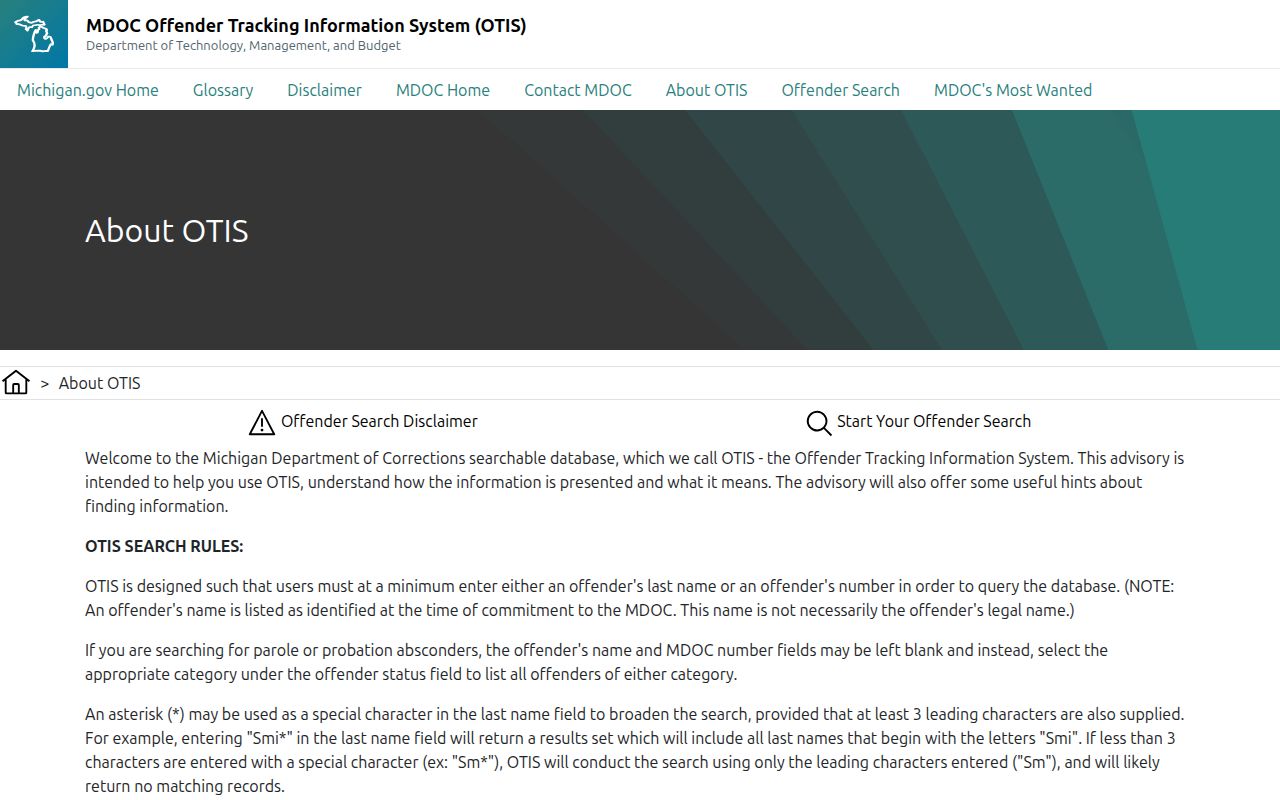
The screenshot supports field interpretation, not a personal date prediction. Read the selected person's current profile and every active sentence.
Livingston County Jail Release Dates
A pretrial person at Livingston County Jail has no sentence-based projected release date. A bond decision, dismissal, remand, or later court order may change custody. Remand means the court directs continued detention. Even after bond is paid, another warrant or agency hold can prevent community release. Payment and physical exit are different events.
For a county sentence, the judgment and court-awarded jail credit form the legal base. Jail credit is time the court recognizes toward the sentence. The jail then performs its administrative computation under applicable law and the actual order. Livingston has not published a calculator or a general weekend-adjustment rule. Ask for an existing calculation or the release field rather than asking staff to create a hypothetical date.
The 53rd District Court search covers misdemeanors and felony preliminary proceedings. The 44th Circuit Court search holds felony trial and sentencing records. The official Circuit Court interface appears below.
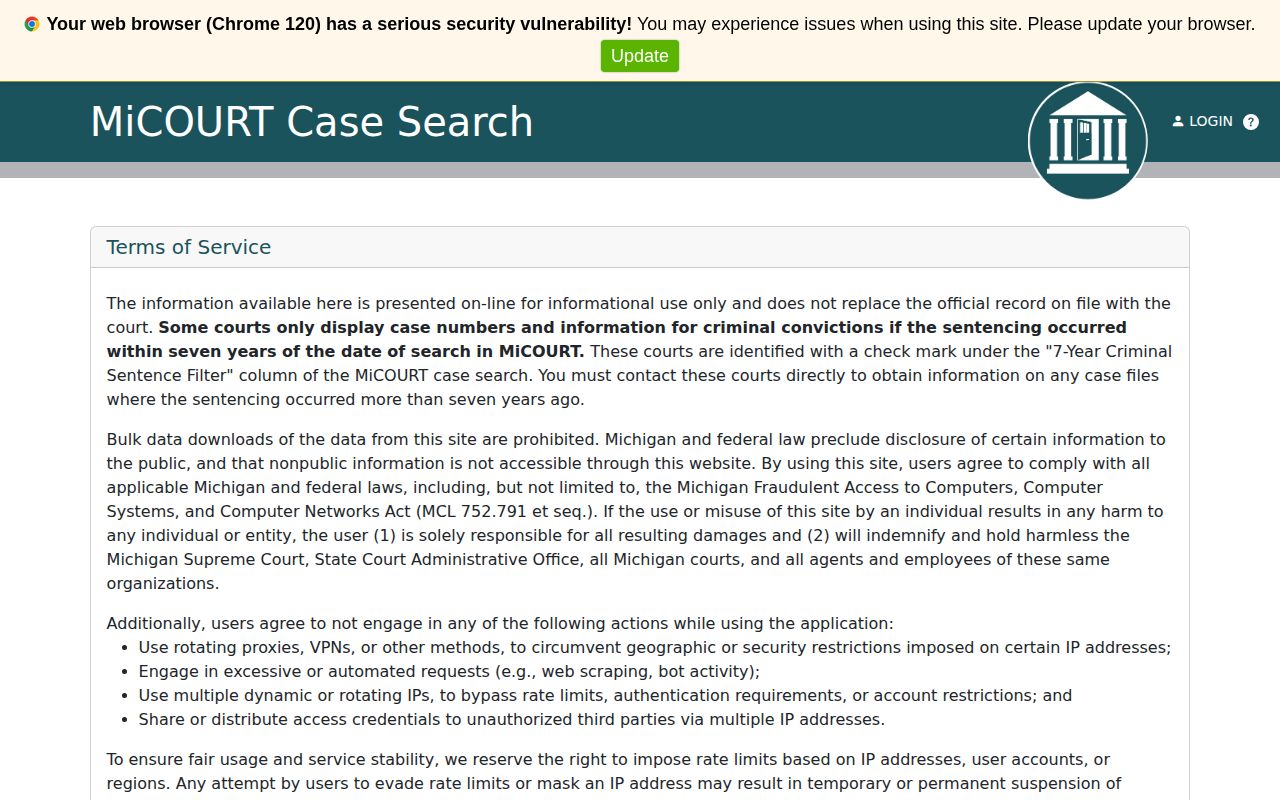
The register can reveal a sentence, jail credit, later order, or violation event. Exact physical release time still belongs to the Livingston County Jail movement record.
For durable proof, a sheriff request should identify the person, booking date or short date range, and any known booking number. Ask for the existing field or log that shows release date and time, the release or disposition code, its definition, and movement entries that distinguish community release from transfer. Michigan FOIA does not require an agency to answer a new calculation question or create a report. A request for the recorded field is more precise. Livingston's electronic county portal accepts written requests, and asking for an electronic copy plus an itemized cost estimate can keep the request focused.
Michigan Truth-in-Sentencing Dates
Michigan must not be described as a universal “serve 85 percent” state. For covered truth-in-sentencing offenses, the prisoner generally must serve the full judicial minimum before parole eligibility. MDOC states that truth-in-sentencing prisoners do not receive good-time or disciplinary credits that cut that minimum. The offense date and statute choose the applicable regime.
Michigan's Corrections Code supplies the statutory framework. MCL 791.234 addresses when a prisoner becomes subject to Parole Board jurisdiction, while MCL 791.233 governs parole release and its required findings. MCL 800.33 applies to good-time or disciplinary credits in certain older cases. MCL 800.34 governs disciplinary time, which is an adverse result of major misconduct rather than an earned credit.
Michigan's 1998 change first reached specified assaultive offenses committed on or after December 15, 1998. Other covered offenses followed for conduct on or after December 15, 2000. Good time generally applies only to certain older sentences and is unavailable for crimes committed after April 1, 1987. Those dates show why one simple formula cannot fit all cases.
- Minimum term
- The court-set term normally served before parole eligibility under the governing law.
- Maximum term
- The outer sentence term that can define the potential MDOC discharge boundary.
- Good time
- A credit regime that remains relevant to certain older sentences.
- Disciplinary credits
- Credits for some pre-truth-in-sentencing cases, subject to the applicable law.
- Disciplinary time
- Modern time added to the eligibility calculation after qualifying misconduct findings.
Livingston Sentence Computation Checks
Michigan indeterminate felony sentences often pair a judicial minimum with a maximum, then give the Parole Board authority after eligibility. The correct reading starts with each sentence and offense date. Next, determine whether terms run concurrently, at the same time, or consecutively, one after another. Add court-awarded jail credit only as the official computation applies it. Then identify the lawful credit regime and review Board action.
The MDOC time-computation source explains the agency's role. Certain older disciplinary-credit cases may receive five days per month plus up to two more days for exceptional conduct, with MDOC describing a maximum annual reduction of 84 days. That historic rule must not be applied to a later truth-in-sentencing case.
A focused MDOC records request can name the Time Review & Disposition, CAX-119 Parole Board Order for Parole, CSJ-169 Parole Processing Checklist, CSJ-170 Discharge Processing Checklist, or CSJ-130 Certificate of Discharge/Termination of Sentence. Exact document names reduce ambiguity. A public requester should seek particular nonexempt records, not expect the full restricted PENPACK.
Why Livingston Release Dates Change
A date can move because the facts or legal inputs change. Some changes alter eligibility. Others affect the practical day of release even after a grant. The responsible agency's current calculation controls.
| Factor | Possible effect | Best record to check |
|---|---|---|
| Corrected judgment or resentencing | Changes the term, credit, or controlling sentence | Sentencing court order and updated computation |
| Consecutive sentence | Extends the combined time before release or discharge | All judgments and OTIS sentence entries |
| Older credit loss or determination | Changes a date under the applicable historic regime | MDOC time review |
| Misconduct and disciplinary time | Can delay Board jurisdiction in covered modern cases | Official MDOC computation |
| Detainer or active hold | Can lead to transfer or continued custody elsewhere | Jail movement, warrant, and receiving agency |
| Parole grant, denial, deferment, or rescission | Controls whether eligibility becomes a release | Board decision and later OTIS status |
| Data correction | Replaces an incorrect public field | OTIS after court or MDOC correction |
The Parole Board's ordinary process is individual. It reviews the file, statutory factors, eligibility, and an interview or other review. A result can be a grant, denial, deferment for more review, or rescission after an earlier grant. The state's public-hearing registration page mainly concerns Lifer Law, commutation, and pardon matters; it is not a complete calendar of routine parole consideration. Quarterly decision reports count grants, denials, and deferrals, but they do not provide a name-search result for one Livingston person. OTIS and a person-specific decision record are the stronger checks.
Note: A detainer is another authority's request to hold or transfer a person, so it can prevent a planned community release.
Confirm Livingston Actual Release Dates
When the date is near, check the current status instead of relying on an old screenshot. OTIS covers MDOC prisoners, parolees, probationers, and recently discharged people. Livingston-linked MI-VINE can report custody events, but a no-match is not proof of release. The jail can clarify a county movement within disclosure limits, and a narrow sheriff records request can seek the exact release date, physical release time, reason, and receiving agency.
For notifications, the Livingston County VINE inmate check explains how to follow a specific record. For durable state proof, seek the discharge certificate or parole order as applicable. For durable county proof, pair the jail movement record with the signed court order. If the movement was to MDOC, ICE, another jail, or federal custody, call it a transfer and continue in the receiving system.
OTIS generally retains discharged people for three years after supervision discharge. MDOC's past-prisoner records contact covers records up to six years post-release, while older matters may require the Archives of Michigan. Different systems have different public horizons. Missing data is never a sound basis for inventing a date.