
Livingston Released Mugshot Records
A mugshot, more formally called a booking photograph, records a person's appearance during a particular booking. It can remain in agency files after the person leaves Livingston County Jail. The image alone does not state the case result. Booking charges are allegations, and they may differ from a later dismissal, plea, verdict, or sentence. The court register is the right place to read that later legal history.
Michigan does not require Livingston County to place every booking photograph on the web. A photograph held by the sheriff is evaluated under Michigan's Freedom of Information Act and any applicable exemption or redaction rule. Public-record status can support a request, but it does not force proactive online publication. The record holder makes the disclosure decision under law.
A state image has a different origin. An OTIS photograph belongs to the MDOC offender record and is not proof that the person was booked in Livingston County. A registry image is narrower still. It appears only for a person who qualifies for public listing in that specific registry.
Livingston Released Mugshot Sources
Use the channel that created the image. Livingston's official jail site did not expose a current roster, a released-person filter, a booking-photo field, or a sheriff jail app during the research sweep. That negative finding makes a focused sheriff records request the main route for a county booking image.
| Channel | Has a photo? | How to access it |
|---|---|---|
| Livingston sheriff website or release feed | No verified public image feed | Do not substitute another Livingston County or an unofficial jail site |
| Sheriff mobile app | No verified Livingston jail app | Do not relabel VINE as a sheriff app |
| Livingston County Sheriff records | Potentially, subject to review | Request the booking photograph for a named booking and date |
| MDOC OTIS | Sometimes | Open the matched state offender record within OTIS scope |
| Michigan PSOR | Yes for publicly listed qualifying registrants | Search the official registry and read its status limits |
| Agency release or news report | Sometimes | Check date, caption, source, and case context |
| Third-party archive | Sometimes | Treat only as a lead and confirm with the source agency |
The Livingston County 24-hour release options explain why the local fallback uses VINE, the jail, court records, and FOIA rather than a nonexistent recent-release gallery.
No Livingston Release Photo Feed
No verified official Livingston County, Michigan roster or rolling release list was found. That means there is no truthful local feed field, photo retention period, or update schedule to describe. A person can also drop from a custody display after release, so a live roster would not be a durable photo archive even if one later appears.
VINE is a custody-event and notification system. It should not be described as the sheriff's mobile app or as a permanent mugshot repository. A VINE status can support a reported release or transfer event, while the photograph request remains with the agency that made the booking. For a named person's full release path, use the Livingston County released inmate records process.
Note: Recheck official Livingston and Michigan sources before publication because a later agency portal could change this verified negative finding.
Request Livingston Booking Photographs
Michigan FOIA, 1976 PA 442 and MCL 15.231 through 15.246, is the formal path for existing executive and local agency records. Livingston County provides an electronic FOIA portal and a downloadable request form. A special form is not required, but the written request must describe the record well enough for staff to locate it.
- Name the person and provide date of birth, booking number, and booking date or a short date range when known.
- Ask for the “booking photograph” tied to that booking. Add the booking sheet or release field only when those existing records are also needed.
- Request an electronic copy, an itemized fee estimate, and notice before costs exceed a stated cap.
- Submit through the county portal or the published written route. Keep the confirmation and a copy of the wording.
- Review any redaction or denial notice for the cited legal basis and appeal information.
Under MCL 15.235, a covered public body generally has five business days to grant, deny, partly grant and deny, or issue notice of one extension of up to ten business days. Authorized labor, copying, media, and mailing charges fall under MCL 15.234. MCL 15.243 contains exemptions. Livingston Central Records also says most sheriff reports take seven to ten days to process, but that local estimate is not a promise for every photo request and does not replace the statutory response framework.
Livingston County Sheriff Central Records150 S. Highlander Way
Howell, MI 48843
(517) 546-2440
Monday through Thursday, 7:00 a.m. to 5:30 p.m.
Friday, 7:00 a.m. to 5:00 p.m.; closed county holidays
Livingston State Offender Photographs
MDOC OTIS may display a photograph for a prisoner, parolee, probationer, or recently discharged person within its scope. Search by the unique MDOC number when known, or use a last name and filters. Compare the offender number, birth date, sentence, status, and location before treating the image as a match.
OTIS excludes jail-only cases, people convicted but not yet sentenced, unavailable electronic images, exempt data, and people beyond its normal three-year public window after supervision discharge. “Parole” means release from prison with MDOC supervision still active. “Discharged” means MDOC jurisdiction ended, subject to the displayed reason. Neither label makes the image a Livingston County booking photograph.
The Michigan Public Sex Offender Registry is another official but narrow image source. Its public interface is shown below.
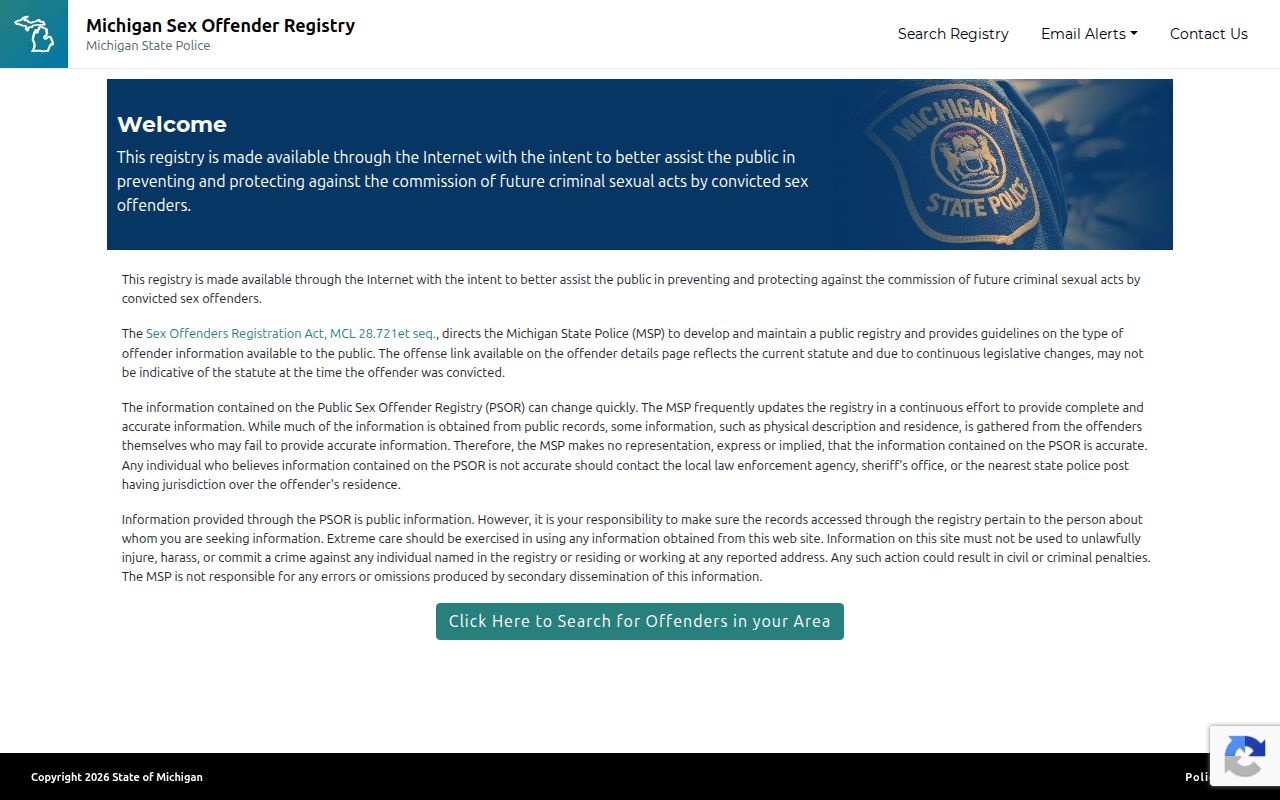
The registry can show a photo, aliases, marks, qualifying offense, and published status for a listed registrant. It is not a general Livingston released-inmate search, and no result proves nothing about a past booking.
Livingston Mugshot Context Checks
Agency press releases and local news reports can preserve a photograph after release. They are historical and contextual sources, not live custody systems. Read the publication date. Identify whether the caption attributes the image to Livingston County Jail, MDOC, a registry, police, or another agency. Then check the relevant court and custody record for the case outcome and current status.
Commercial and third-party archives can be stale, mix people with similar names, confuse Michigan with another state, omit the disposition, or keep an image long after custody ends. No commercial mugshot publisher or data broker is linked or endorsed. When an image appears only in an outside archive, use it solely as a lead and return to the sheriff, MDOC, registry, or court for confirmation.
A photograph's continued availability says nothing about present custody. It also cannot establish that the pictured person was convicted of the booking charge. The most sound record set pairs the correct image source with the booking identifier, release or transfer entry, and final court disposition.
Livingston Mugshots After Set-Aside
Michigan automatic set-aside processing began April 11, 2023. Under Michigan Clean Slate and MCL 780.621 et seq., qualifying conviction and related arrest or sentence information can become nonpublic or redacted. The restricted record may still exist for uses authorized by law. Set-aside is sometimes called expungement, but the controlling order and statute define its effect.
MCL 780.621g governs eligibility and exclusions. MCL 780.623 preserves a restricted nonpublic record, while MCL 780.622 generally treats the person as not previously convicted subject to exceptions. Court rules also require redaction of affected conviction information from public releases. An old public image trail can therefore become incomplete even though the booking historically occurred.
The correction path begins with the court or agency record affected by the set-aside. Confirm that the order reached the Michigan State Police, court, sheriff, or MDOC system as applicable. A set-aside does not promise that every independent publisher will delete a prior copy. A missing official photo also must not be treated as proof that no booking ever took place.
Avoid Livingston Mugshot Site Traps
The official Livingston County Jail page warns that the similarly named LivingstonCoutyJail.org is not an official county site and should not be used for information or inmate payments. The misspelled “Couty” in that domain is a key warning sign. An unofficial page cannot supply an authoritative release event, booking image, or records-request rule.
Search results also surface a Livingston County Sheriff's site from Missouri that publishes “Released Inmates.” It belongs to Chillicothe, Missouri, not Livingston County, Michigan. Check the government domain, state name, address, and telephone area before trusting a photo. This county-name trap is especially serious because a real image attached to the wrong jurisdiction can still look convincing.
Use only the Michigan county portal, MDOC, Michigan State Police registry, and the correct Livingston courts for official facts. If a search result lacks a clear Michigan government source, do not use it to identify a person, claim a release, or send money.
Note: The research found no enacted Michigan statewide anti-pay-to-remove mugshot law, so no such protection or removal promise should be claimed.
Livingston Mugshot Retention Limits
Each source keeps and displays records under a different rule. Livingston has no published recent-release photo-feed retention window because no such official feed was verified. OTIS generally displays people discharged within three years of supervision discharge, then directs older questions to records channels. MDOC lists a past-prisoner records contact for up to six years post-release, with still older questions going to the Archives of Michigan.
Court and sheriff source files follow their own schedules, disclosure rules, exemptions, and set-aside effects. News and independent archives may retain copies after an official source changes. This mismatch is why a single missing or present image cannot answer current custody, final case result, or whether a record remains publicly available elsewhere.
- Booking photograph
- The image made during a specific arrest and booking event.
- Release record
- The agency field or movement log showing how and when custody ended or transferred.
- Disposition
- The court's later result, such as dismissal, plea, verdict, or sentence.
- Set-aside
- A Michigan legal process that can make qualifying conviction-linked material nonpublic.