
Livingston Parole and Probation Systems
Three supervision channels operate in Livingston County. The Michigan Parole Board decides parole for felony offenders committed to the Michigan Department of Corrections. MDOC Field Operations Administration then manages parole in the community. It also supervises circuit-court probation cases that fall within MDOC. Separately, the 53rd District Court runs local probation for district-court cases. The court, not the county jail, is the key source for that third type.
Parole is conditional release from prison while the sentence and MDOC jurisdiction continue. Probation is a court-ordered period in the community and does not by itself prove that the person served a prison term. Discharge means the term of supervision or MDOC jurisdiction has ended. Those terms are not interchangeable. A person can be out of a cell yet still be under active rules, reporting duties, and agency oversight.
| Supervision | Who imposes or grants it | Best public check | What it means |
|---|---|---|---|
| Parole | Michigan Parole Board | MDOC OTIS status and location | Prison confinement ended, but the sentence continues under MDOC |
| MDOC probation | Circuit court | OTIS plus the 44th Circuit Court record | Community sentence supervised through MDOC |
| District probation | 53rd District Court | District court register and probation office | Local court supervision outside the parole system |
| Discharge | MDOC or the sentencing court | Discharge date, reason, or signed court order | Supervision ended, subject to the exact record |
Verify Livingston Post-Release Supervision
Begin with the system that matches the sentence. MDOC OTIS includes current prisoners, parolees, and MDOC probationers, plus discharged people within its public retention window. A normal search needs a last name or the unique six-digit MDOC number. Name searches can also be narrowed by status, age range, gender, race, or identifying marks. Compare identity details before relying on a result.
- Search OTIS by MDOC number when known. Otherwise, use the name and relevant filters.
- Read the exact Status field. Look for PAROLE, PROB, DISCHRG, ABSCOND1, or ABSCOND2 rather than inferring status from a photograph.
- Check Location and the displayed dates. Location can point to a supervision office, but an absconder location may only be the last assigned office.
- Search the sentencing court when the person is absent from OTIS or when the type of probation is unclear. Use the 53rd District Court for district matters and the 44th Circuit Court for felony records.
- Contact the identified office for current, lawfully disclosable details. Record the date of the check because supervision information can change.
OTIS does not cover jail-only sentences or every local probation case. The full Livingston County released inmate search path explains how jail, court, VINE, and state records fit together when no one system answers the question.
Livingston Supervision Offices Differ
Livingston County has separate MDOC parole and probation offices in Howell. Local district probation is a third channel. Calling the wrong office can lead to an incomplete answer, so use the OTIS Location field or the sentencing court before placing a call. The official MDOC Region 9 office directory identifies the state offices.
Livingston County Parole Office2530 E. Grand River
Howell, MI 48843
(517) 546-7088 Livingston County Probation Office
210 S. Highlander Way
Howell, MI 48843
(517) 546-4212 53rd District Court Probation
204 S. Highlander Way
Howell, MI 48843
(517) 546-5950
The parole office serves people released from an MDOC prison under Board authority. The MDOC probation office handles state-supervised circuit cases. District-court probation is tied to the local court. None of these offices should be treated as the Livingston County Jail records unit.
Note: Published research did not supply office hours, so call before visiting and confirm which office owns the supervision record.
Livingston Parole Board Records
The Michigan Parole Board is the sole paroling authority for felony offenders committed to MDOC. It reviews the file, eligibility, statutory factors, and an interview or other review. A result may be grant, deny, defer, or later rescission. An earliest release date only marks the point when the Board can act on an eligible sentence. It is not a grant. For district probation, the Livingston County 53rd District Court remains the local source.
The official Parole Board information page describes that process. It should not be confused with the state public-hearing registration page. That calendar is mainly for Lifer Law, commutation, and pardon hearings, not every routine parole review. Quarterly Board reports aggregate results but are not a name-search system.
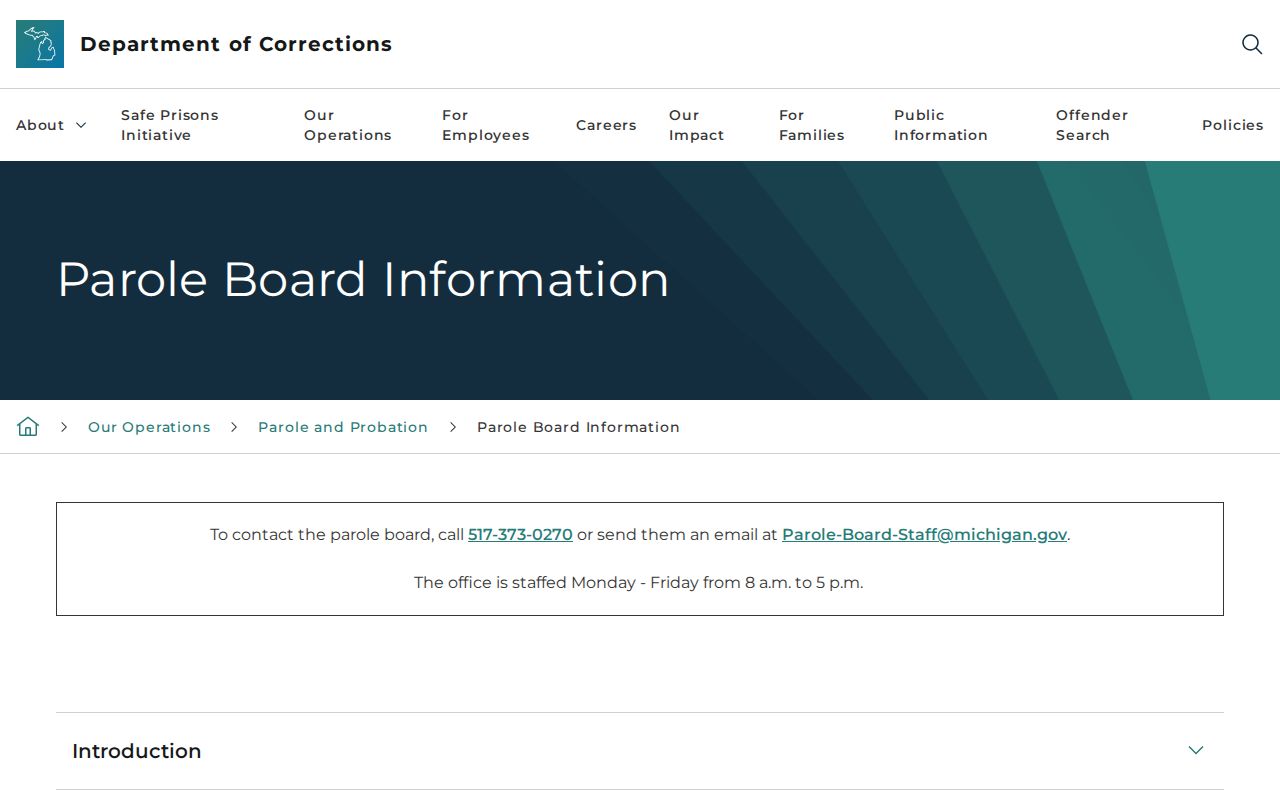
The official Michigan Parole Board source is illustrated below. The image helps identify the page that explains Board procedure, while the matching person’s operative status must still be checked in OTIS.
A grant becomes a completed release only after processing and resolution of other active holds. Direct victims who qualify for added hearing and decision notices register with MDOC Crime Victim Services at (877) 886-5401.
Livingston Supervision Absconder Codes
An absconder is a person whom the supervising agency says failed to remain available or comply with required reporting. It is not a successful discharge. OTIS uses precise codes: ABSCOND1 means an MDOC parole absconder who is actively sought, while ABSCOND2 means a probation absconder under the sentencing county’s jurisdiction. The displayed Location may be the last assigned supervision site rather than the person’s present location.
OTIS permits a statewide absconder-category search even without a name or number. That function helps interpret status, but it is not a Livingston County released-person list. For an error in supervision or absconder data, contact the listed parole or probation office. MDOC also publishes an absconder and escapee tip number, (517) 755-0855. A court warrant should be read from the issuing court or agency rather than guessed from a roster absence.
Michigan’s Public Sex Offender Registry uses the word “Absconder” in a narrower registry sense: the registrant left the last reported address and the current location is unknown. Registry status is not proof of parole, probation, or discharge.
Livingston Release or Prison Transfer
Livingston County Jail publishes a property rule that can help explain a confusing departure. When a person is sentenced to prison, personal property may be released to a family member Monday through Friday, from 8:00 a.m. to 4:00 p.m. That fact may point to a transfer into MDOC rather than a return home. A transfer remains custody.
Verify the movement through the jail record, court sentence, and then OTIS after MDOC receives and enters the person. If OTIS data is inaccurate or stale, MDOC directs correction questions to correctionsinfo@michigan.gov. Court-derived sentence errors should go to the sentencing court. These separate correction routes matter because the office that created the data is best placed to fix it.
Livingston Supervision Terms and Violations
Parole and probation conditions are the rules imposed by the Board, court, or supervising agency. They can include reporting, approved residence or travel, treatment, testing, payments ordered by a court, and compliance with the law. The person-specific order controls. A public status label cannot safely reveal every condition, and no condition should be invented from the type of case.
An alleged violation may lead to a hearing, warrant, detention, changed conditions, or revocation. Revocation means supervision is withdrawn and custody may resume under lawful process. It is not the same as a new conviction. The Livingston 53rd District Court case search can show violation hearings and orders for probation matters. MDOC and Board records govern parole action.
- Parole
- Conditional release from prison while MDOC jurisdiction continues.
- Probation
- A court sentence served in the community under stated rules.
- Absconder
- A supervision status alleging the person is unavailable or has stopped required reporting.
- Revocation
- A formal end to community supervision that may return the person to custody.
- Discharge
- The recorded end of supervision or sentence jurisdiction.
Note: VINE reports custody events, while OTIS and the sentencing court are the better sources for the legal supervision status.
Livingston Supervision Discharge Proof
Supervision ends through an official discharge or termination, not merely through a missing online result. In OTIS, DISCHRG means MDOC jurisdiction ended. The record may pair that code with a date and reason. MDOC explains that discharge can follow successful parole or probation, reaching a prison maximum, or death before completion, so the reason must be read with the status.
OTIS generally keeps discharged offenders in its public system for three years after supervision discharge. Past that horizon, MDOC lists MDOC-Records_Retention@michigan.gov for past prisoner records up to six years post-release and the Archives of Michigan for older archival questions. A focused records request can seek the CSJ-130 Certificate of Discharge/Termination of Sentence. Public users should not be promised a full PENPACK because MDOC limits that package to recognized criminal-justice authorities conducting official business.
Other precisely named MDOC records may answer a narrower question. CAX-119 is the Parole Board Order for Parole, while the Time Review & Disposition can document computation work. CSJ-169 is the Parole Processing Checklist, and CSJ-170 is the Discharge Processing Checklist. A request for the final, nonexempt document tied to one person is more useful than a broad demand for every file. Current prisoner record questions go to Corr_Records_Info@michigan.gov. Past prisoner questions within MDOC's stated horizon go to the retention address, and formal FOIA requests go to MDOC-FOIA@michigan.gov.
A signed court order is the stronger route for district or other court probation. Michigan set-aside law can later make qualifying conviction and related material nonpublic. Therefore, absence from OTIS or a court search is not affirmative proof that supervision never existed.